
SOLUTIONS
From the data to a well-founded decision.
This is something many companies that are already using AI are familiar with.
The system has generated a response.
It is unclear where it comes from.
The validation logic is in the prompt.
No one can say whether it's still true today.
The system is trading.
You don't realize if it's right until after the fact.
What moresophy offers instead.
Full Traceability
Each statement is traced back to a specific data point.
Logic Instead of Chance
Validation logic runs as versioned skills, not as prompt instructions.
Controlled Release
Defined approval gates instead of add-ons: Control as an architectural principle.
What moresophy Offers—A Complete Range of Solutions Tailored to Your Company's Specific Needs
AI systems used in critical processes must do more than just respond. They must evaluate, draw conclusions, make decisions, prepare—and take action once a human gives the go-ahead.
moresophy covers this entire process: from analyzing existing data to synthesizing new documents and deriving recommendations, all the way through to controlled execution in leading systems.
| Starting Point | What the moresophy platform does | Example |
|---|---|---|
| Analysis | Evaluate data, identify patterns, report findings | Framing analysis, diagnostic support |
| Synthesis | Generate a document or response from sources | Customer service response, filling out a request for proposals |
| Planning | Evaluate options, justify recommendations | Risk assessment, sales management |
| Plot | Enter data into systems, trigger processes | Claims settlement, order entry |
AI Solutions in Use
Example from Practice
Analysis
The system reads. You decide.

Sentiment alone isn't enough. Which framing dominates? What causal relationships are implied, and which perspectives are systematically excluded?
The system analyzes texts for linguistic and semantic interpretive frameworks—based on a domain-specific glossary maintained by subject matter experts. Each framing assignment is traced back to specific passages in the text—in a reproducible and auditable manner.
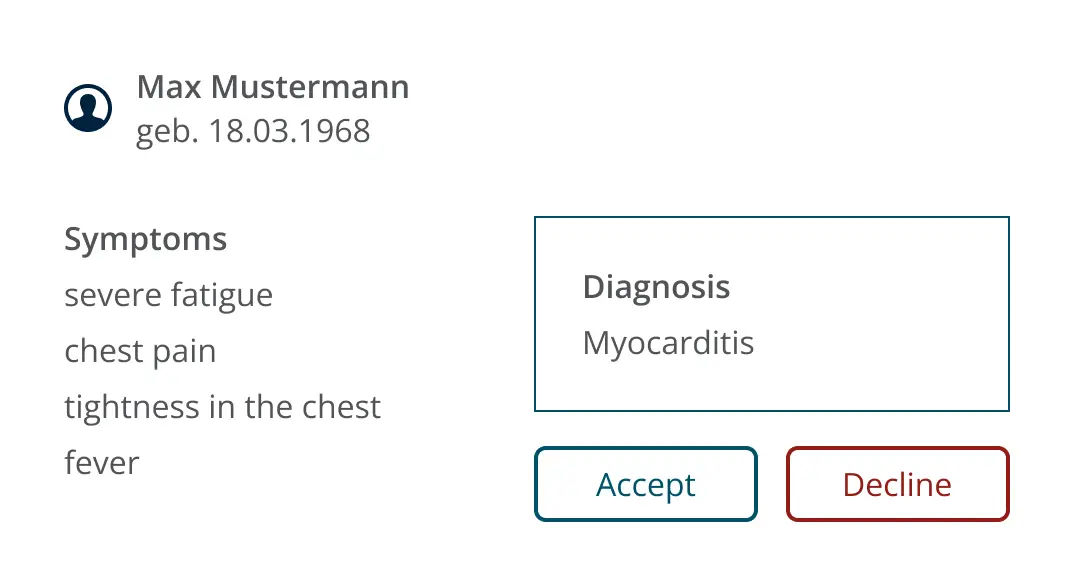
Diverse patient data—medical history, lab results, imaging, and previous diagnoses—are quickly synthesized into prioritized diagnostic hypotheses.
Every hypothesis is based on specific data points: lab results, symptoms, and time course. The system makes a recommendation; the physician makes the decision—with a chain of reasoning that must be legally and ethically sound. On-premises operation is possible.
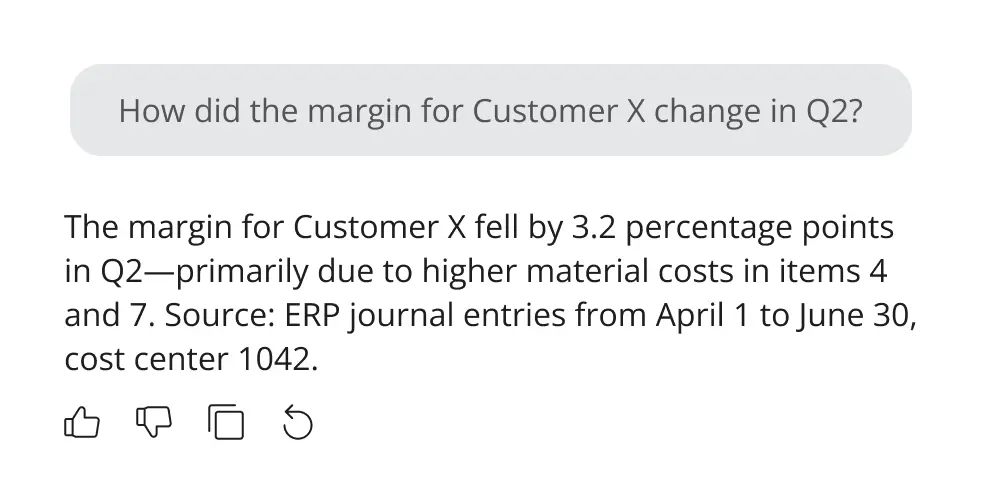
Executives no longer wait for manually compiled Excel reports. Questions such as “How did the margin for Customer X change in Q2?” are asked directly—and answered immediately, based on the latest ERP data, with a reference to the specific data record. No reliance on BI tools, no need for IT intervention.
Synthesis
Sources become a result.
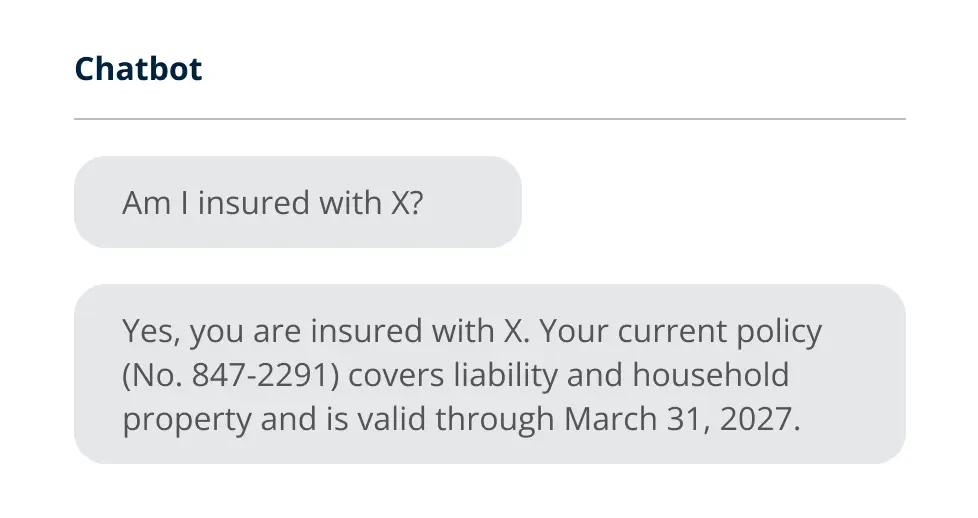
"Am I insured with X?" – The answer depends on the plan, coverage amount, term, and exclusions. The system combines the knowledge base (what applies in general?) and policy data (what applies to this policy?) into a single, personalized response.
Every statement is traced back to a clause in the General Insurance Conditions (AVB) or a contract feature. The claims adjuster reviews and sends the document—quality assurance lies not in typing, but in decision-making.
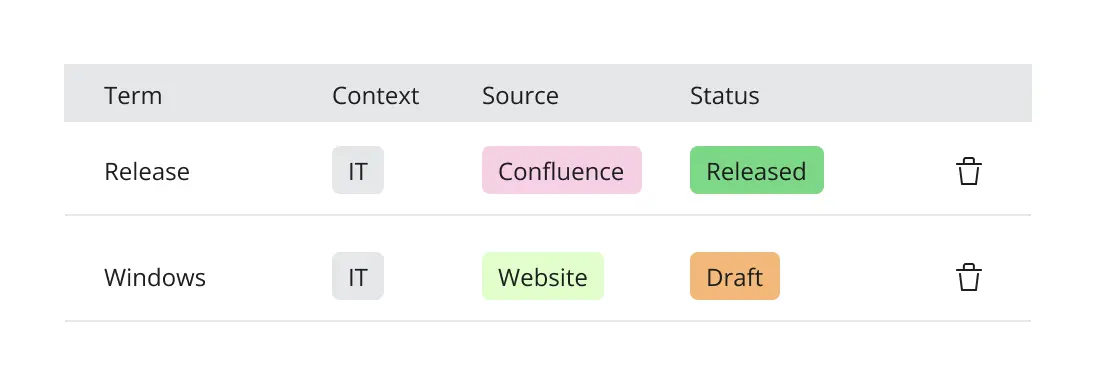
One term. Three different meanings. If misinterpreted, this can lead to incorrect database queries, inaccurate billing, and regulatory risks.
The system detects ambiguity, guides the user through a structured clarification dialogue, and only then executes the precise query. The clarification of terms is logged. The glossary can be maintained by subject matter experts—without a ticket system and without involving developers.
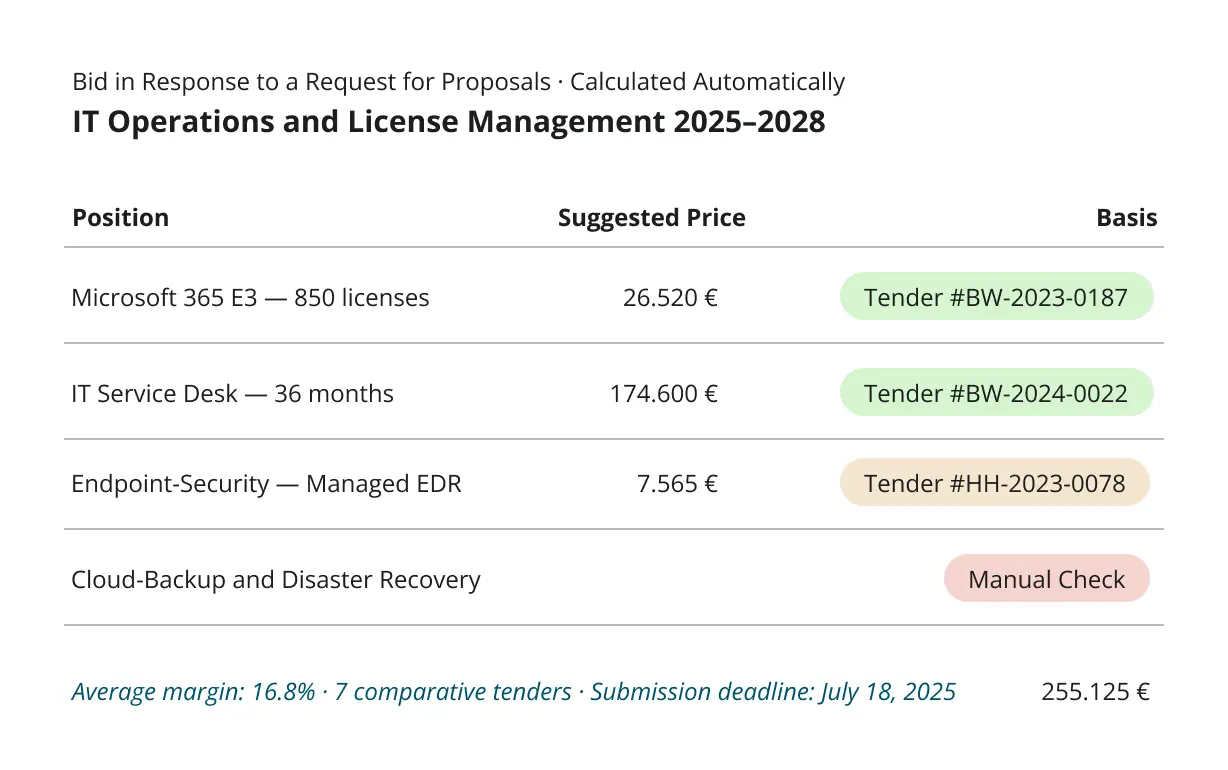
Bids are time-sensitive and synthesize product knowledge, historical prices, current margins, and customer requirements.
The system analyzes the incoming request for proposal, compares line items with historical tenders and ERP data, and generates price proposals with a detailed cost breakdown.
Every proposal is based on specific historical bids and current margin parameters—no estimates, no guesswork.
Planning
The system makes suggestions. People make the decisions.
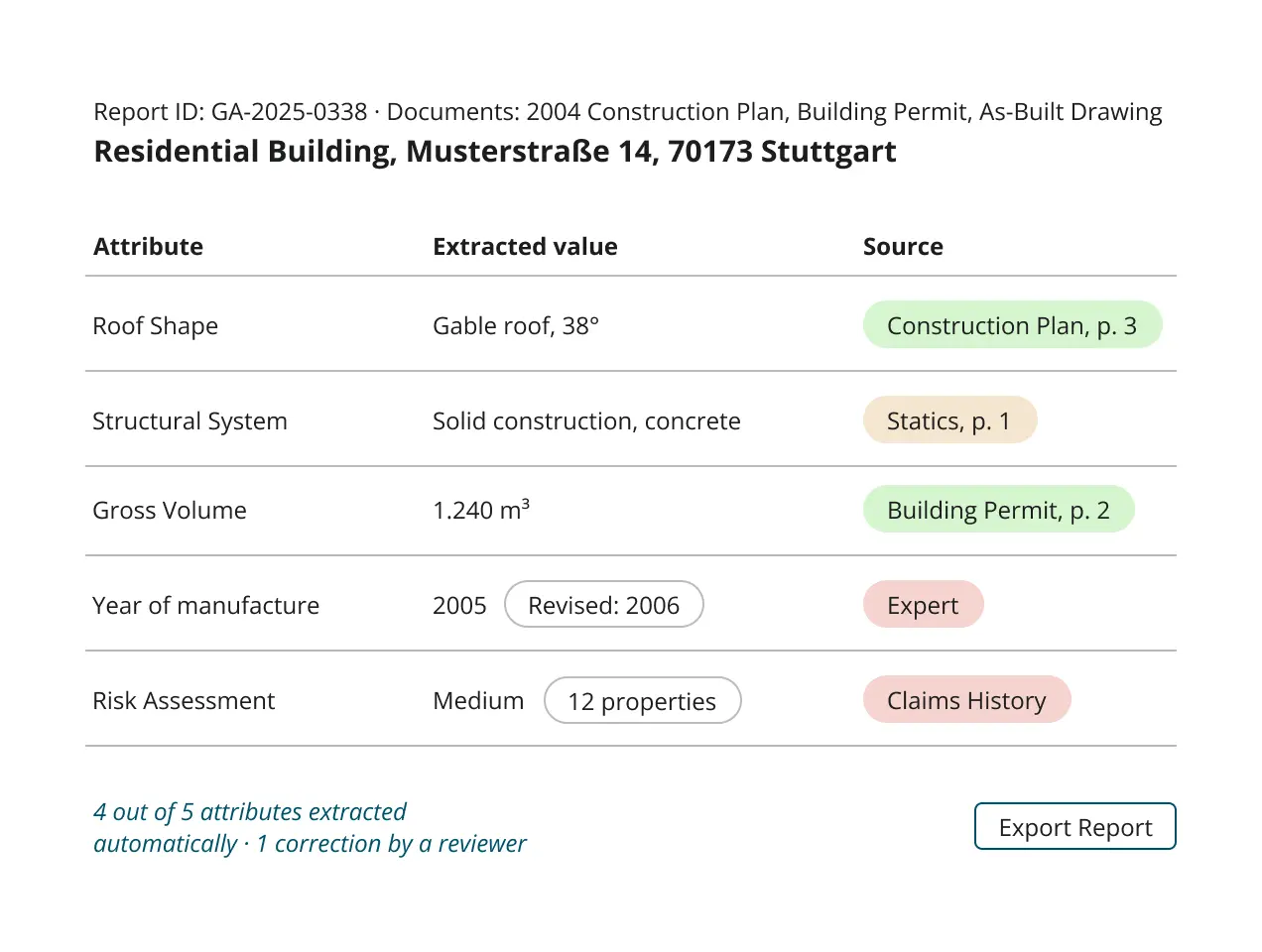
Today, appraisers review construction plans and property documentation manually—and enter attributes such as roof shape, structural system, or gross floor area by hand into appraisal forms.
The system extracts structured building attributes from construction documents, providing direct source citations for each attribute, compares them with historical damage data, and derives substantiated risk assessments.
The reviewer reviews and corrects the work—based on a prepared, transparent set of results.
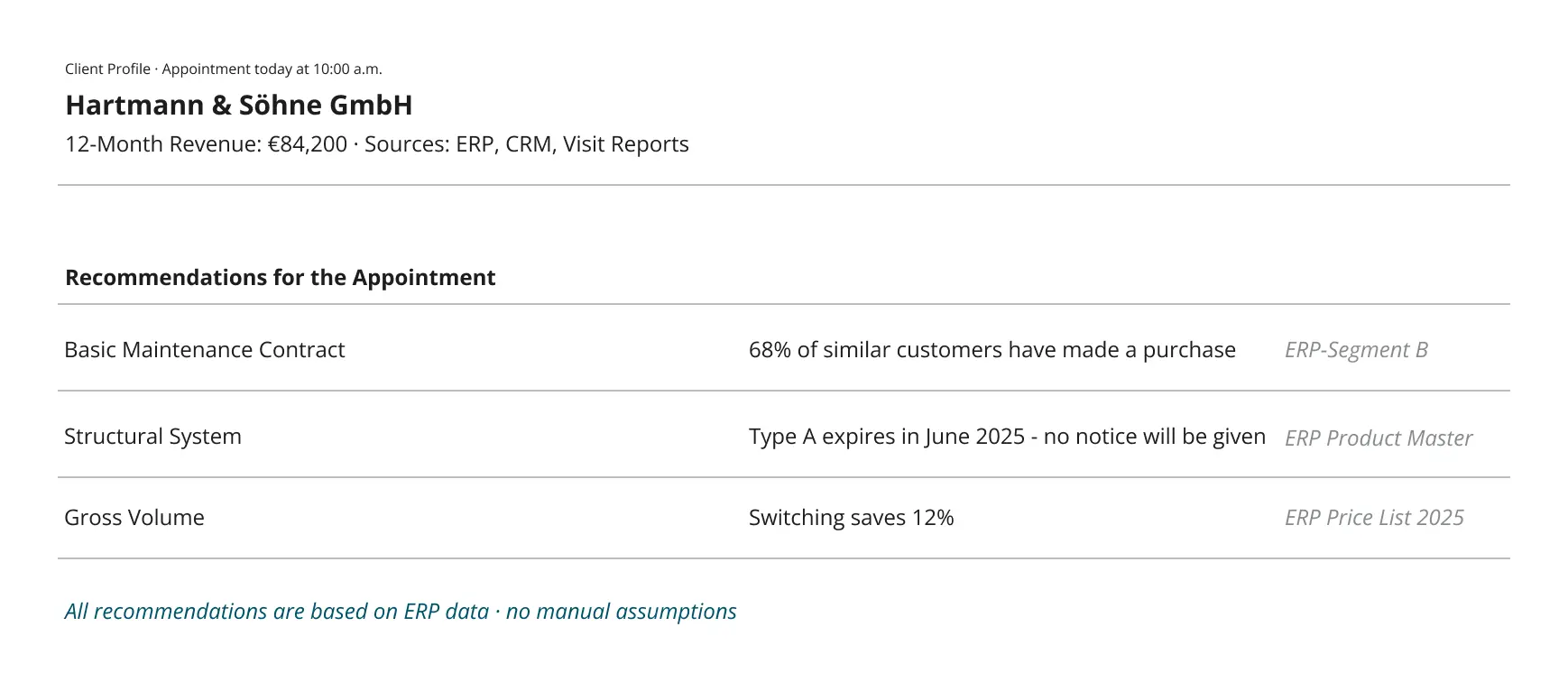
Customer appointments are prepared manually—ERP, CRM, notes—all kept separately. Cross-selling opportunities are not systematically identified.
Before the appointment, the system generates a customer profile based on purchase history, recent visit reports, and product data—including prioritized recommendations based on the purchasing patterns of similar customers.
The recommendation "Refer to Product X" is based on specific ERP data, not mere speculation.
Plot
The system executes the trade. Upon approval.
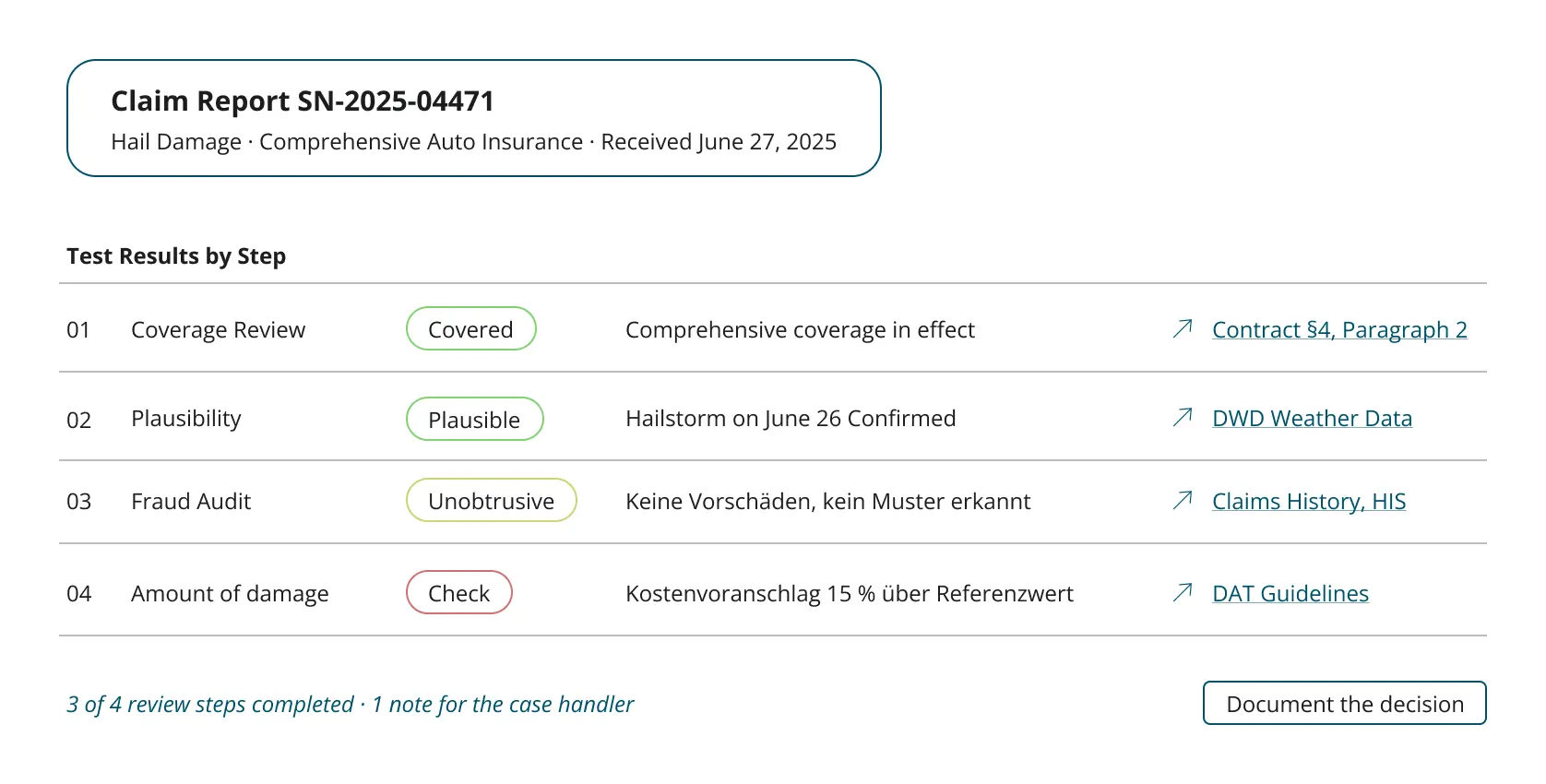
Today, claims are manually reviewed against policy terms, external reference data, and fraud indicators—with inconsistent thoroughness and at great expense in terms of time.
The system checks coverage, plausibility, and fraud patterns simultaneously, in a single run, with complete documentation for each step of the review. The claims adjuster makes the decision—based on a well-reasoned recommendation, not an opaque score. In clear-cut cases: direct settlement without a manual intermediate step.
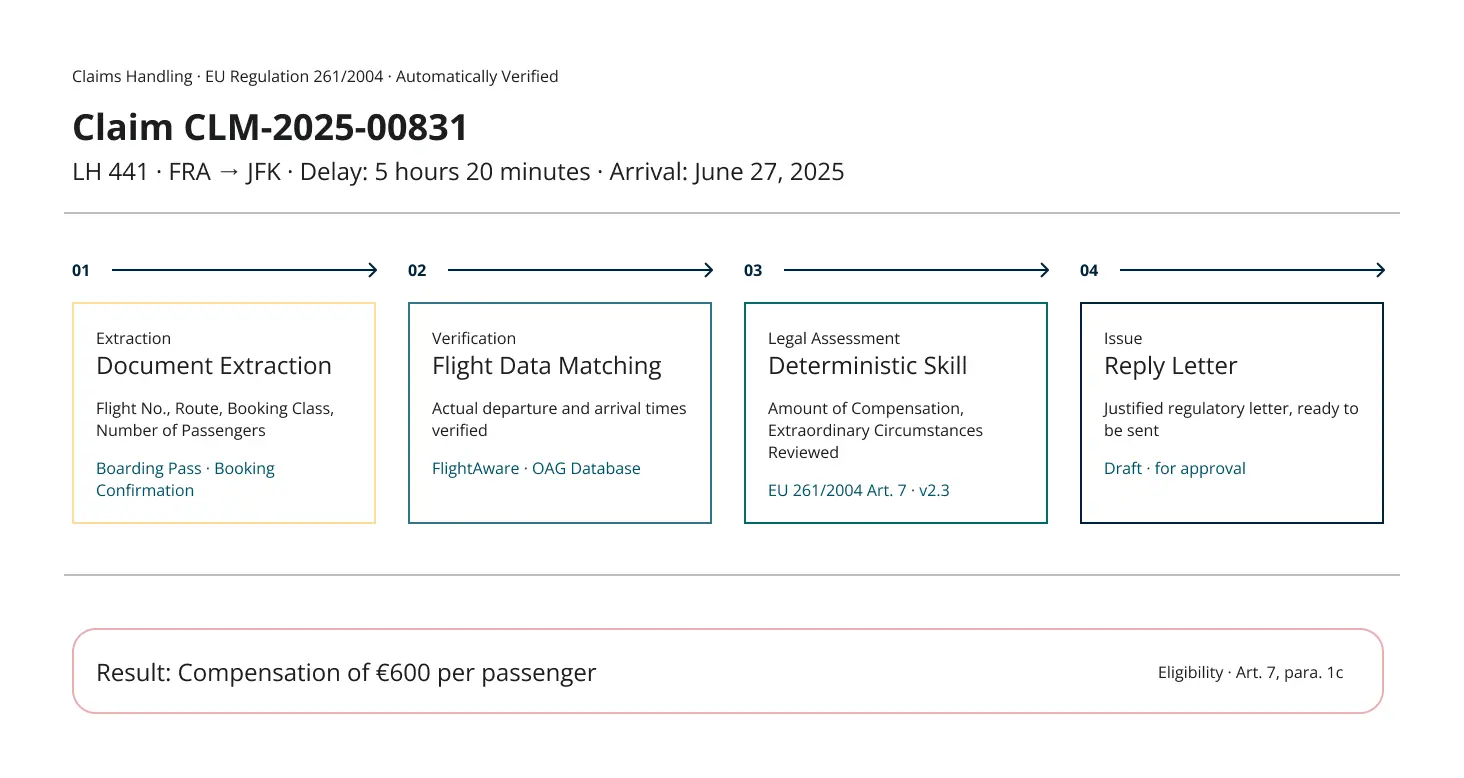
Compensation claims under the EU Regulation are governed by specific rules—but are data-intensive. The system verifies flight data against external databases, assesses the claim using deterministic legal logic, and generates the response letter. Crucially, the legal logic is not embedded in the language model—it is implemented as a tested, versioned skill that does not interpret but rather verifies.
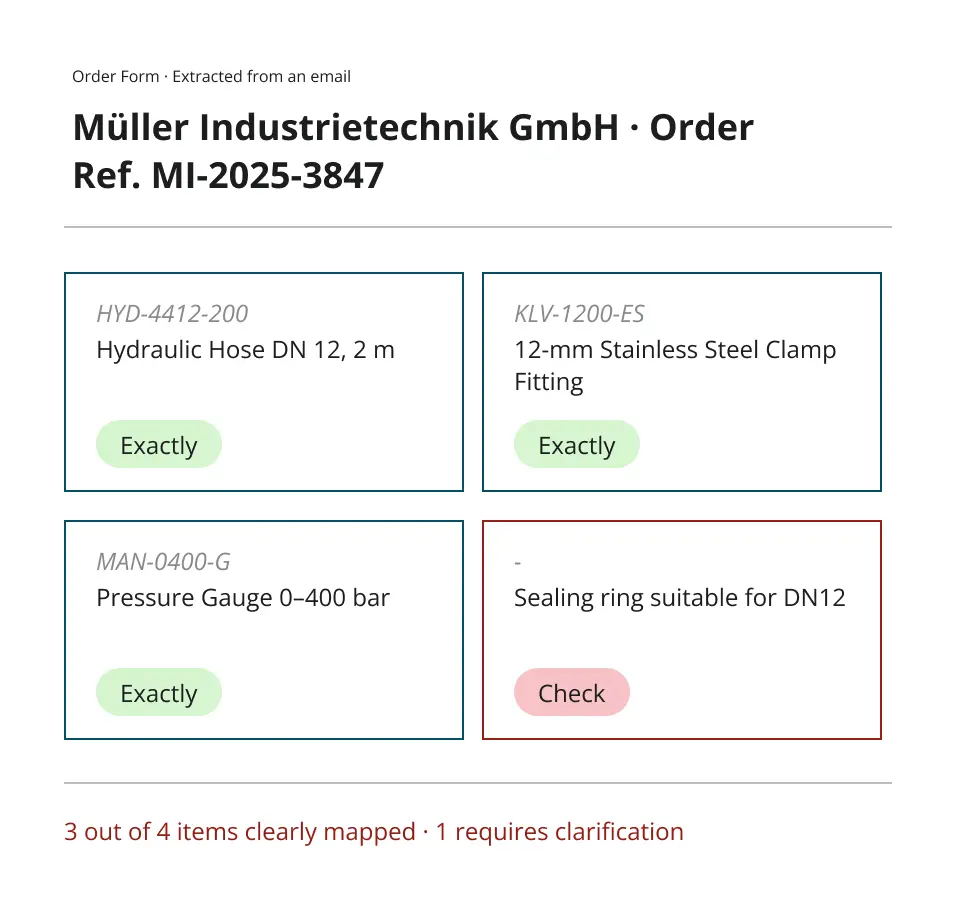
Incoming orders received via email are manually entered into the ERP system—a process that is error-prone, slow, and dependent on staff availability.
The system reads incoming emails, extracts order information, maps it to ERP master data, and forwards the prepared transaction for approval. For unique orders: Direct transfer with a log. Mapping to ERP numbers is deterministic—it involves assignment, not interpretation.
Can't find your use case here?
Or has the exact starting point not yet been identified? That's not an obstacle.
The basic pattern is the same across the board: data that lies dormant in isolation; decisions that require explanation; and growing demands for compliance and transparency.
01 Scattered Data That Can’t Be Reconstructed
02 Decisions That Must Be Auditable
03 Increasing Regulatory Requirements
Please contact us. Together, we’ll figure out what’s possible in your specific situation.
What Sets Us Apart from a RAG System
A retrieval system finds the relevant passage. That’s enough for simple information-seeking queries.
It is not enough for the conclusion to be derived from multiple data points. When a decision must be auditable. When the system triggers an action that writes to a leading system.
We don’t guarantee that an answer will come—we ensure that the right conclusion follows from the right data points. And that every step along the way is traceable.
| Criterion | Generic AI Agent / RAG | moresophy |
|---|---|---|
| Data Binding | Statistical | Explicit – per reasoning step |
| Auditability | Not available | Complete trace |
| Action Control | Difficult to control | Human-in-the-loop at defined gates |
| Validation Logic | In the prompt | As a deployable, versioned skill |
| Regulatory Suitability | Limited | Compliant by Design |
See what it looks like in your process.
We'll show you a demo featuring a use case from your industry—and explain what's relevant to your situation.