
GLOSSARY: LIFECYCLE MANAGEMENT
A concept.
A truth
Everywhere.
Because your knowledge is unique—and terms shouldn’t simply mean whatever a language model happens to consider plausible at the moment.
Conceptual ambiguity is the hidden flaw in every AI system.
Departments think in silos—and each silo assigns its own meaning to the same words. What one thing means in a contract text means something else in copyright law. Generic AI systems either guess at this point or ignore the ambiguity entirely. The result is not an error message, but an incorrect answer that appears to be correct.
Other systems leave the interpretation up to the language model.
GLM clarifies it—explicitly, in a documented manner, and at the source.
A proliferation of glossaries does not solve the problem of terminology.
Most companies don’t have too few glossaries—they have too many, which are poorly maintained and lack accountability. The problem just shifts; it doesn’t go away.
What this means in practice:
01
Different departments interpret the same terms differently—which causes friction even without AI.
02
Every AI tool makes its own, unchecked assumptions about controversial terms.
03
Glossaries become outdated because no one is responsible for maintaining and publishing them.
One concept. One truth. Everywhere.
Automatic Identification of Term Candidates
GLM automatically identifies terms with specific meanings from your sources—on a recurring basis, not as a one-time project.
One term, multiple contextual meanings
No duplicate chaos: a single entry, organized by context. Consistent across all systems.
Foundation for Reliable Reasoning
For People and AI
The glossary serves both as a tool for subject matter experts and as a knowledge base for AI.
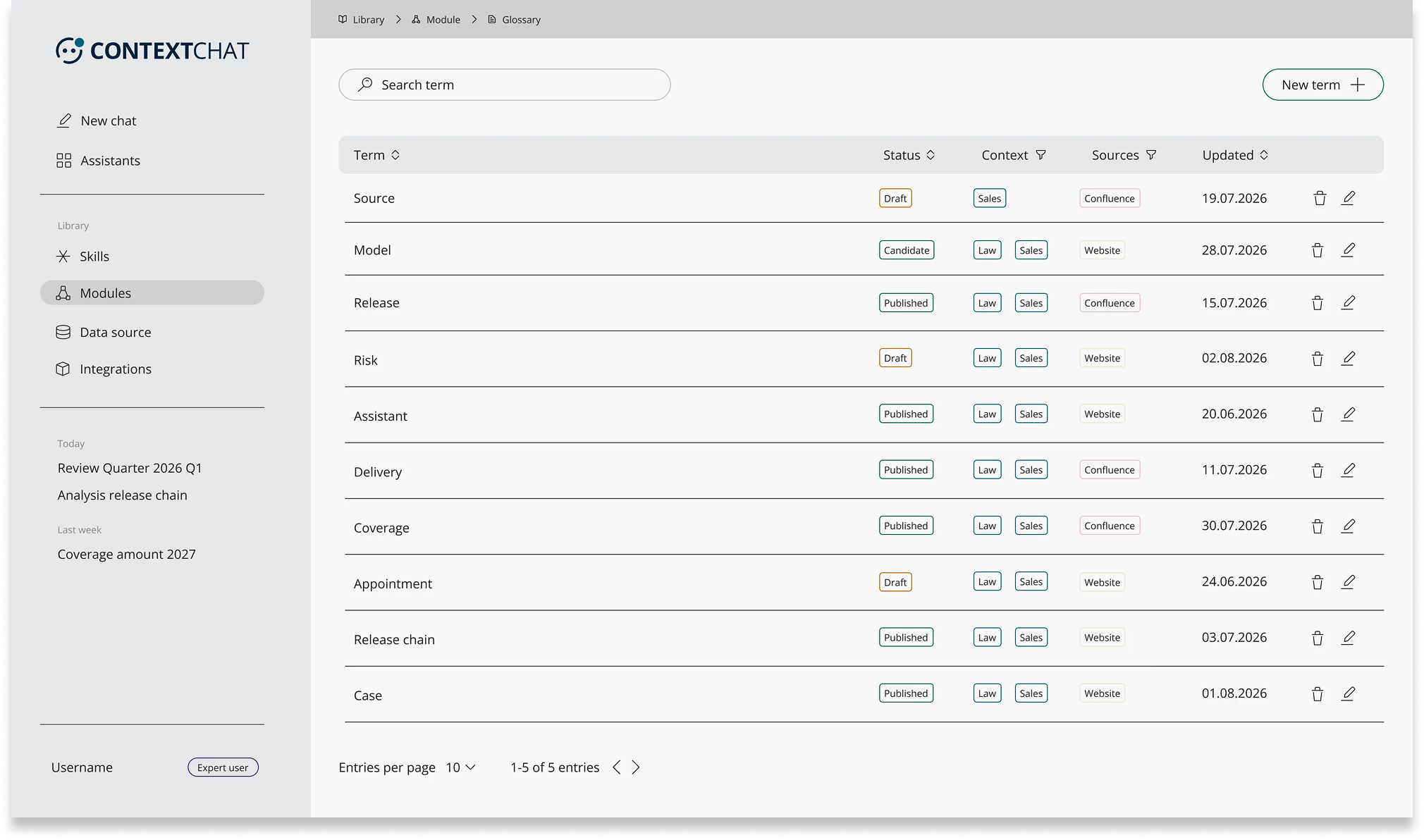
Structural principle: one entry instead of many copies.
There is exactly one entry in the glossary for each term. Domain-specific meanings are not represented by separate data records or context flags, but rather as structured sections within the term description—general meaning, followed by a section titled “Specific Meaning in the ⟨Context⟩ Domain”. GLM automatically derives the contexts themselves from the content sources, such as a web page’s URL path or the Confluence space.
Knowledge that lives on.
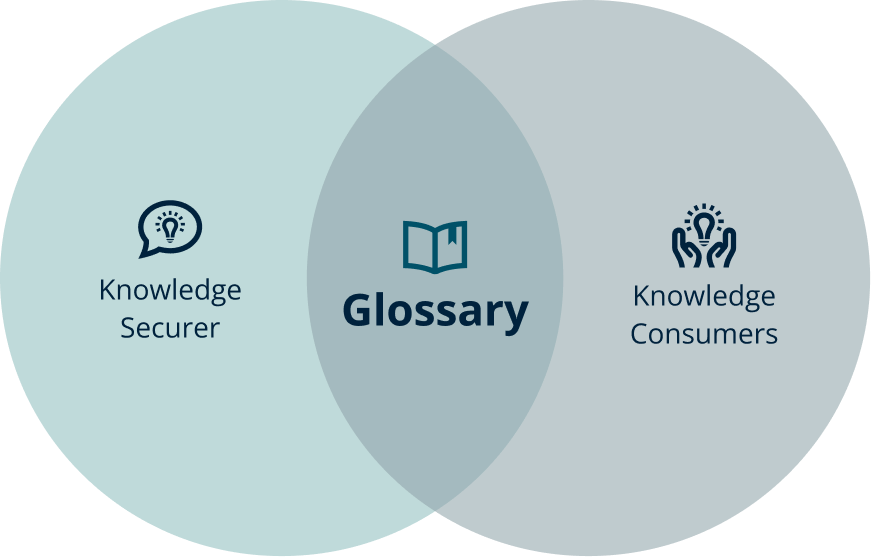
A glossary that is created once and never updated is already outdated on the day it is published. GLM treats technical terminology as an ongoing process—one that bridges the gap between those who preserve knowledge and those who use it. Both cycles converge at a single point: quality-assured contextual information that applies equally to humans and AI.
Knowledge Securer
Validate glossary terms, identify contexts, and generate context-specific entries—a cycle that keeps the glossary up to date rather than archiving it.
Knowledge Consumers
Without GLM: One word, eight truths.
Take a single term: “claim.” Without a context-sensitive glossary, chance determines which meaning a system adopts. GLM distinguishes between meanings rather than conflating them.
Eight meanings, one term, one entry
| "Claim" in … | Meaning |
|---|---|
| General | Claim / Assertion |
| Marketing | Brand Promise |
| Trademark Law | Advertising claim eligible for trademark protection |
| Strategy | a field with multiple meanings |
| Patent Law | Patent Claim |
| Project Management / Construction | Additional Claim / Addendum |
| Insurance | Claims / Reporting a Claim |
| IT | Statement on Digital Identity |
| Music Rights Management | Enforcement of Rights in Works |
GLM in Practice
“At GVL, we are using KiWi (AI Knowledge Management) to create a reliable and unified AI landscape to support knowledge-intensive tasks. Instead of fragmented solutions, we develop specialized AI assistants that are integrated into our processes and deliver reproducible results based on quality-assured data—enabling consistent, well-founded decisions and sustainable optimization.”

Gesellschaft zur Verwertung von Leistungsschutzrechten
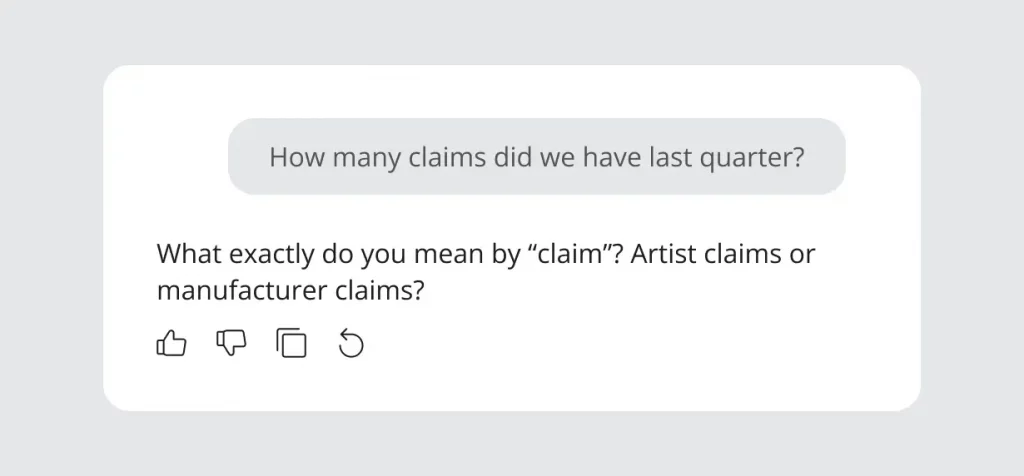
It is precisely this fragmentation that GLM resolves. At GVL, the term “claim” has different meanings depending on the area of exploitation: it refers either to a performing artist’s claim to a share of a music production based on documented participation—or to a sound recording producer’s claim to the rights in a work, based on the original production of the sound recording.
If a staff member asks, “How many claims did we have in the last quarter?”, GLM recognizes the term as ambiguous—even before selecting an index—and asks a specific follow-up question: Artist claims or producer claims? The count begins only after this has been clarified. The result: not a guessed number, but a verified one.
Where GLM is used in practice.
From clarifying rights to customer communication: Clarifying terminology is most valuable in situations where misunderstandings can be costly.
Learn how your company's knowledge can be expressed in a single, reliable language.
Curious to know which terms are already being interpreted differently within your company? Talk to us.